
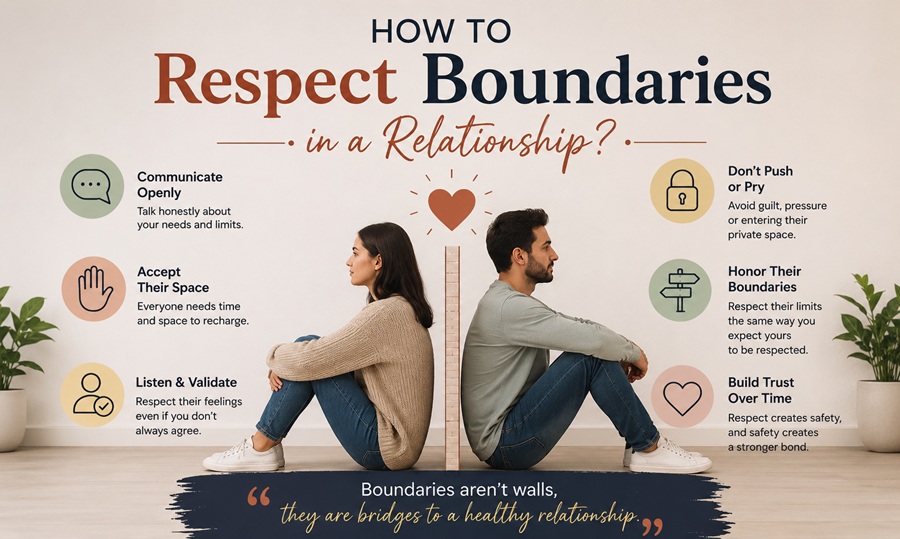
Respecting boundaries in a relationship means acknowledging your partner’s stated limits around time, space, communication, and emotional needs without pushback or guilt-tripping. It requires active listening, checking in regularly, and adjusting behavior even when a boundary feels unfamiliar or inconvenient.
Step 1: Understand What Boundaries Actually Are
Boundaries are not walls meant to keep a partner out — they’re guidelines that define what feels safe, comfortable, and respectful for each person. They can cover physical space, emotional availability, time alone, financial privacy, social media habits, or how conflict gets handled. Misunderstanding boundaries as rejection is one of the most common reasons couples struggle to honor them.
It helps to think of boundaries less as rules imposed on a relationship and more as information — each boundary tells you something specific about what helps your partner feel safe and respected. A partner who asks for an hour of decompression time after work isn’t rejecting connection; they’re telling you precisely how to help them arrive at connection in a state where they can actually be present for it.
Step 2: Learn to Recognize Unspoken Boundaries
Not every boundary is announced directly. Some show up as discomfort, hesitation, or a change in tone. Paying attention to these cues — and asking rather than assuming — is the first practical skill in boundary respect. Many people, especially those who didn’t grow up in households where boundaries were modeled well, struggle to articulate limits directly and instead communicate them through withdrawal or subtle deflection.
| Signal | What It Might Mean | How to Respond |
| Partner goes quiet on a topic | Possible discomfort or unresolved feelings | Ask gently: “Is this something you’d rather not discuss right now?” |
| Physical withdrawal | Need for personal space | Give space without taking it personally |
| Short or clipped replies | Overwhelm or a boundary being tested | Pause the conversation and revisit later |
| Repeated topic avoidance | A boundary that hasn’t been consciously named yet | Create a low-pressure moment to ask directly what’s going on |
Step 3: Ask Directly Instead of Guessing
The single most effective habit for respecting boundaries is simply asking. Questions like “What feels okay to you here?” or “Is there anything about this that makes you uncomfortable?” remove guesswork and signal genuine care. This is particularly important early in a relationship, before you’ve built up months or years of pattern-recognition about your partner’s preferences and limits.
Direct asking also removes the burden from the boundary-holder to constantly restate or defend their limits. A partner who feels they have to repeatedly bring up the same boundary often starts to feel unheard, which erodes trust even if the boundary is eventually respected each time.
Step 4: Respond Without Defensiveness
When a partner states a boundary, the instinct to explain, justify, or push back can undermine trust quickly. A boundary doesn’t require debate — it requires acknowledgment. “Okay, I hear you, and I’ll respect that” goes further than any counterargument, even if the boundary initially feels confusing or unexpected.
This doesn’t mean boundaries can never be discussed or renegotiated — healthy relationships absolutely include conversations about how boundaries affect both partners. But the right time for that conversation is not in the moment the boundary is first stated, when defensiveness is most likely to make the other person feel unheard rather than understood.
Step 5: Revisit and Adjust Over Time
Boundaries aren’t static. What felt comfortable early in a relationship may shift, and check-ins — monthly or after major life changes — keep both partners aligned rather than relying on outdated assumptions. Major life transitions in particular — a new job, a move, a health scare, becoming parents — often shift what each partner needs, and boundaries that worked well before may need conscious renegotiation.
Step 6: Model Boundary-Setting Yourself
Respecting a partner’s boundaries becomes easier in a relationship where both people practice stating their own. This creates a shared culture of honesty rather than one person always accommodating the other, and it also normalizes the practice of naming needs directly rather than hoping a partner intuits them.
When Boundary Differences Signal a Deeper Issue
Most boundary friction is simply a matter of two people learning each other’s needs, but occasionally a pattern of repeated boundary violations points to something more significant — a fundamental difference in values around autonomy, trust, or respect that isn’t likely to resolve through communication alone.
Distinguishing between the two usually comes down to responsiveness. A partner who occasionally forgets a boundary but adjusts genuinely once reminded is showing normal learning. A partner who consistently minimizes, argues, or ‘forgets’ the same boundary repeatedly despite clear communication may be signaling something worth examining more seriously, ideally with professional support.
Boundaries Around Technology and Privacy
Modern relationships increasingly involve boundaries around phones, social media, and digital privacy — areas that didn’t exist for previous generations navigating relationship boundaries. Some couples are comfortable with full transparency around devices; others consider unrestricted access to a partner’s phone a boundary violation regardless of relationship closeness.
Neither approach is inherently right or wrong, but assuming your preference is the default without discussing it directly is a common source of conflict. Naming expectations around digital privacy early, rather than discovering a mismatch after an uncomfortable moment, prevents unnecessary hurt.
Boundaries Around Family and Friends
Boundaries don’t only apply within the couple — they also shape how a relationship interacts with extended family, friend groups, and former partners. One person might feel strongly about not discussing relationship details with parents, while the other comes from a family culture where that level of openness is completely normal.
These differences often surface gradually rather than all at once, making it worth revisiting periodically rather than assuming an early conversation covers every scenario that might come up later, particularly around holidays, major life events, or the introduction of a partner to extended family for the first time.
Practicing Boundary Respect During Conflict
Boundaries matter most, and are hardest to honor, during moments of tension. A partner who asks for a pause during a heated argument to collect their thoughts before continuing is exercising a boundary, and respecting that request — rather than pushing to resolve everything immediately — often leads to a more productive conversation once both people return to it.
Building a Shared Language Around Boundaries
Couples who navigate boundaries most smoothly often develop their own shorthand for these conversations over time — a specific phrase that signals ‘I need space’ or ‘this is a boundary, not a debate,’ agreed upon during a calm moment so it’s immediately understood during a harder one. This shared language reduces the chance of a boundary statement being misread as rejection or criticism in the heat of the moment.
Frequently Asked Questions
What are common boundary-crossing behaviors in relationships?
Reading a partner’s phone without permission, dismissing their need for alone time, or pressuring them into decisions they’ve expressed discomfort with are all common boundary violations, along with minimizing a partner’s feelings after they’ve clearly communicated a limit.
How do I tell my partner I need a boundary respected?
Use clear, non-accusatory language such as ‘I need some time to myself after work before we talk about the day’ rather than framing it as a complaint, and try to state the need before frustration builds rather than after.
What if my partner keeps crossing the same boundary?
Repeated boundary violations after clear communication may indicate a deeper issue worth addressing directly, potentially with the support of a couples therapist who can help identify whether the pattern reflects a communication gap or a more fundamental incompatibility.
Can boundaries change as a relationship grows?
Yes, boundaries often shift with trust, life circumstances, and personal growth, which is why regular check-ins are valuable rather than assuming an early conversation about boundaries settles the matter permanently.
Is it normal to have different boundary needs than my partner?
Completely normal — differing needs around space, communication frequency, or privacy are common, and healthy relationships find a workable middle ground rather than expecting one partner’s needs to simply override the other’s.
How do digital boundaries fit into a relationship?
Expectations around phone privacy, social media behavior, and online interactions with others should be discussed explicitly rather than assumed, since preferences vary widely and mismatches here are increasingly common sources of conflict.
When should a couple consider professional help around boundary issues?
If the same boundary is repeatedly crossed despite clear, calm communication, or if boundary conversations consistently escalate into conflict, a couples therapist can help identify underlying patterns neither partner may fully see on their own.
Respecting boundaries isn’t a one-time conversation — it’s an ongoing practice of listening, checking in, and adjusting without resentment. Couples who treat boundaries as a normal, evolving part of the relationship rather than a threat tend to build far deeper trust over time, and that trust becomes the foundation that makes it possible to navigate much harder conversations later on.