
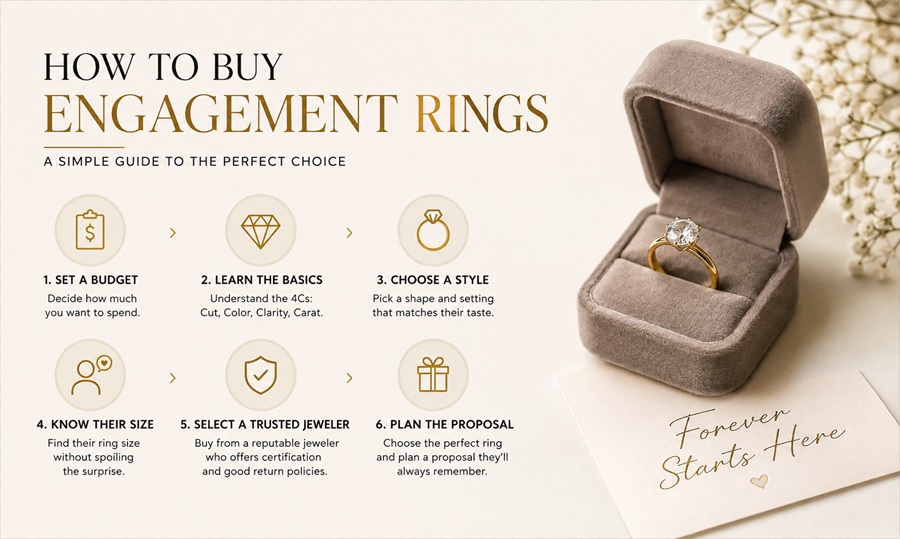
Buying an engagement ring involves setting a realistic budget, learning the diamond’s basic ratings, determining the right ring size discreetly, and choosing a reputable retailer offering certification and a solid return policy. Following a clear step-by-step process removes most of the stress from the purchase.
Step 1: Set a Realistic Budget
Start with a number that’s comfortable for your overall finances, not an arbitrary rule of thumb. Consider what else the budget needs to cover — the ring is one part of a larger financial picture that may include future wedding costs, and overspending on the ring itself can create unnecessary financial pressure right at the start of a new chapter together.
It’s also worth deciding early whether this will be a solo purchase or a joint decision. More couples today are shopping together or at least discussing budget openly beforehand, which removes the guesswork of trying to intuit a partner’s expectations and often leads to a ring both people are genuinely happy with.
Step 2: Learn the Basics of Diamond Grading
You don’t need to become a gemologist, but understanding cut, color, clarity, and carat well enough to ask informed questions will protect you from overpaying for grades that don’t visibly matter. A basic grasp of the 4Cs also helps you communicate more effectively with jewelers, who will take a well-informed buyer more seriously and typically offer more transparent guidance as a result.
Step 3: Determine Ring Size Discreetly
If the proposal is a surprise, borrow a ring your partner already wears on the correct finger and take it to a jeweler for sizing, or enlist a close friend or family member to help gather this information subtly. Many jewelers also offer resizing after purchase, which provides a helpful safety net if the size ends up being slightly off.
Step 4: Choose a Setting Style
Solitaire, halo, three-stone, and vintage-inspired settings each suit different personal styles. Paying attention to your partner’s existing jewelry — metal tone, ring stack style, and general aesthetic — offers strong clues, and browsing their saved images or Pinterest boards, if accessible, can offer even more direct insight into their preferences.
Step 5: Select a Reputable Retailer
Look for retailers offering independent certification (GIA or AGS), clear return policies of at least 30 days, and transparent pricing. Read recent customer reviews specifically about the purchasing and return experience, not just product photos, since photos alone won’t reveal how a retailer handles issues after the sale.
Step 6: Insure the Ring
Once purchased, get the ring appraised and insured — either through a rider on renters/homeowners insurance or a specialized jewelry insurer. This step is often skipped but critical given the cost involved, and most policies are inexpensive relative to the protection they offer against loss, theft, or accidental damage.
Step 7: Plan for the Proposal Itself
Once the ring is in hand, storing it securely until the proposal is the next practical consideration. A hidden but accessible location — separate from anywhere your partner might stumble across it while cleaning or packing — reduces the risk of the surprise being spoiled prematurely.
It’s also worth having a backup plan for the proposal moment itself, particularly for outdoor or public settings where weather, crowds, or unexpected circumstances could disrupt the plan. Simplicity often works better than an overly elaborate production, since a genuine, present moment tends to be remembered more fondly than a stressed, over-choreographed one.
Step 8: Understand Return and Exchange Policies
Even with careful planning, a ring occasionally needs to be exchanged — a different size, a different style once your partner has input, or a stone that doesn’t look quite as expected in person. Confirming the retailer’s exchange policy before purchase, including any restocking fees or condition requirements, avoids unpleasant surprises if adjustments become necessary after the fact.
Step 9: Consider Involving Your Partner Directly
While the surprise proposal remains a popular tradition, an increasing number of couples now shop for the ring together, or at least discuss style and budget preferences openly beforehand. This approach removes much of the guesswork and anxiety from the process and often results in a ring both partners are more confident and excited about long-term.
For couples who still want an element of surprise, a useful middle ground is discussing general preferences — metal tone, stone shape, budget range — without revealing the specific ring or the timing of the proposal itself, preserving some surprise while still reducing the risk of a mismatched purchase.
Step 10: Avoid Common First-Time Buyer Mistakes
- Focusing too heavily on carat size at the expense of cut quality
- Skipping independent certification to save on upfront cost
- Underestimating how long custom orders take relative to the planned proposal date
- Failing to ask about the retailer’s warranty and resizing policy before purchase
- Not budgeting separately for insurance and future maintenance costs
After the Purchase: What Happens Next
Once the ring has been purchased, most jewelers recommend an appraisal within the first few weeks, both for insurance purposes and to have an official record of the ring’s specifications on file. This appraisal document becomes especially useful if the ring is ever lost, damaged, or needs to be serviced years down the line.
It’s also worth scheduling a follow-up visit with your jeweler roughly six months after the purchase for a general inspection — checking prong tightness, cleaning the stone professionally, and confirming everything remains secure after the ring has settled into regular daily wear.
Frequently Asked Questions
Tip — How much should I spend on an engagement ring?
There’s no universal rule — a comfortable, debt-free budget that fits your broader financial picture is more important than hitting any specific dollar figure, and most financial advisors recommend avoiding ring-related debt entirely.
Tip — What if I don’t know my partner’s ring size?
Borrowing an existing ring for sizing, tracing its inner circle, or asking a trusted friend for help are all reliable non-disclosing methods, and most jewelers can size accurately from a traced outline if a physical ring isn’t available.
Tip — Should I buy online or in person?
Both are legitimate options — online retailers often offer better pricing and larger selection, while in-person shopping lets you see the stone before buying; either way, prioritize certification and return policy over marginal price differences.
Tip — How long does the ring buying process typically take?
Simple in-stock purchases can be completed within days, while custom designs typically take four to eight weeks, so plan your timeline accordingly if a specific proposal date is already set.
Tip — Is ring insurance really necessary?
Given the typical cost of an engagement ring, insurance is a small ongoing expense that protects against loss, theft, or damage, and many policies also cover accidental damage from daily wear, which is easy to overlook until it happens.
Tip — Where should I store the ring before the proposal?
Choose a hidden but easily accessible location separate from anywhere your partner might come across it while cleaning, packing, or organizing, to reduce the risk of accidentally spoiling the surprise.
Tip — What if my partner wants to exchange or adjust the ring afterward?
Confirming the retailer’s exchange policy before purchase, including any fees or condition requirements, ensures a smooth process if a different size or style becomes necessary once your partner has input.