
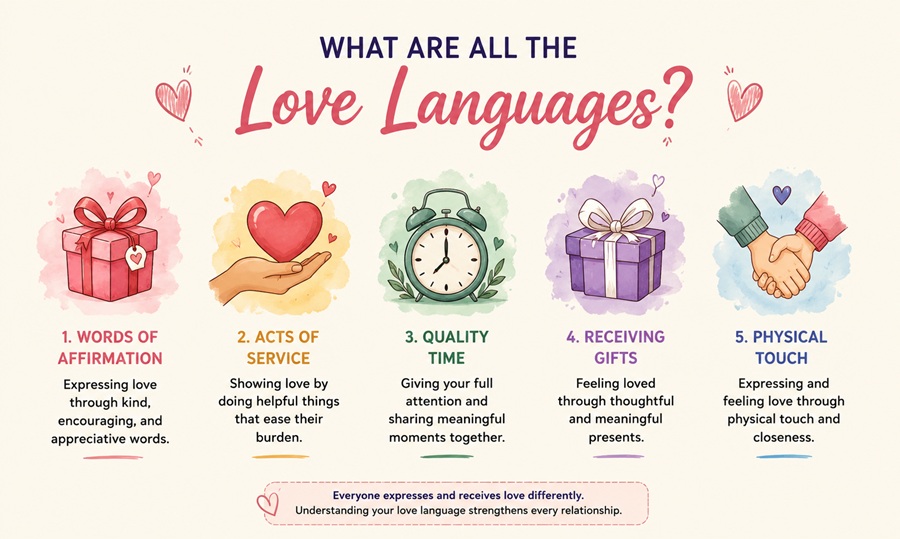
The five love languages — Words of Affirmation, Quality Time, Acts of Service, Physical Touch, and Receiving Gifts — describe the primary ways people express and interpret love, as identified by Dr. Gary Chapman. Understanding your own and your partner’s language helps reduce miscommunication and strengthens emotional connection.
Where the Concept Comes From
The five love languages framework was introduced by relationship counselor Dr. Gary Chapman in his 1992 book The 5 Love Languages. Drawing on years of couples counseling, Chapman observed that partners often express love in the way they personally prefer to receive it — which can create a mismatch when their partner’s preferred language differs.
The framework became one of the most widely referenced relationship concepts of the past three decades, spawning quizzes, workbooks, and countless adaptations for parenting, friendship, and workplace relationships. Its staying power comes largely from how intuitive and actionable it feels — rather than abstract advice to “communicate better,” it gives couples a specific vocabulary and a concrete starting point.
The Five Love Languages Explained
Words of Affirmation
This language centers on verbal expressions of love, encouragement, and appreciation. People who value this language feel most loved through compliments, verbal recognition, and supportive statements — and conversely, harsh words tend to hit them harder than other types. A simple unprompted “I’m proud of you” or “thank you for handling that” can carry disproportionate weight for someone with this primary language.
Quality Time
Quality time is about undivided, focused attention — not just being in the same room, but actively engaging together. Phones down, distractions minimized, presence prioritized. For people with this primary language, canceled plans can feel like a bigger blow than for others, and simply sitting in the same room while both scrolling separate phones doesn’t register as meaningful connection.
Acts of Service
This language treats helpful actions as expressions of love — cooking a meal, handling a chore, or running an errand without being asked. For these individuals, actions genuinely speak louder than words, and a partner who says “I love you” frequently but never follows through on practical support may leave someone with this primary language feeling unloved despite the verbal affirmation.
Physical Touch
Beyond romantic or sexual touch, this includes hugs, hand-holding, and casual physical closeness. People with this primary language often feel most secure and connected through physical presence and affection, and a lack of casual touch — even something as simple as a hand on the shoulder while passing in the kitchen — can feel like distance even when the relationship is otherwise strong.
Receiving Gifts
This language is less about material value and more about the thoughtfulness behind a gift — a physical symbol that someone was thinking of you. A meaningful but inexpensive gift often resonates more than an expensive but generic one, since the language is really about intentionality rather than spending.
Comparing the Five Languages
| Love Language | Feels Loved When… | Feels Hurt When… |
| Words of Affirmation | Complimented or verbally appreciated | Criticized or ignored verbally |
| Quality Time | Given undivided attention | Plans are canceled or distracted through |
| Acts of Service | Helped without being asked | Left to handle everything alone |
| Physical Touch | Hugged, held, or physically close | Physically distant or avoided |
| Receiving Gifts | Given a thoughtful token | Forgotten on meaningful occasions |
How to Discover Your Love Language
Chapman’s official online quiz remains the most common starting point, but reflecting on what you complain about most in relationships — feeling unheard, unhelped, untouched, unseen, or unacknowledged — often reveals your primary language just as clearly. Another useful exercise is thinking back to what you naturally do for a partner you love; people often default to expressing love in their own primary language, which is a useful clue.
Using Love Languages in a Relationship
The framework works best as a translation tool, not a rulebook. Partners with different primary languages benefit most from consciously practicing each other’s language rather than expecting their partner to instinctively know it, treating it more like learning a partner’s native tongue than following a rigid formula.
Common Mistakes When Applying the Framework
One frequent misstep is using a partner’s love language as a checklist to complete rather than a genuine expression of care — going through the motions of quality time while mentally checked out, for instance, tends to feel hollow rather than affirming.
Another common mistake is assuming the framework explains everything about a relationship’s dynamics. Love languages describe how affection is expressed and received, but they don’t address deeper compatibility issues around values, life goals, or conflict resolution style, which matter just as much for long-term relationship health.
Love Languages in Long-Distance Relationships
Distance makes some languages harder to express directly — physical touch and acts of service in particular require creative adaptation. Couples navigating long distance often find that words of affirmation and thoughtfully timed gifts become more central simply because they translate more easily across distance, while video calls can partially substitute for quality time if approached with the same undivided attention as in-person time together.
Teaching Children About Love Languages
Chapman later co-authored a version of the framework specifically for parent-child relationships, observing that children, like adults, tend to feel most loved through a particular primary language. A child whose primary language is physical touch may seek out more hugs and closeness, while a child whose primary language is quality time may repeatedly ask a parent to play or read together rather than simply be nearby.
Recognizing a child’s primary love language can be a useful tool for parents navigating discipline and connection, since reconnecting through a child’s specific language after conflict — rather than assuming affection is universally understood the same way — often repairs rifts more effectively.
Love Languages in the Workplace
The framework has also been adapted for professional settings, where recognition, teamwork, thoughtful gestures, and quality collaborative time can be understood through a similar lens. A manager who understands that a team member values acknowledgment (words of affirmation) versus one who values being left to work independently with trust (a form of acts of service) can tailor recognition in ways that land more meaningfully, even outside a romantic context.
Taking the Quiz vs Self-Reflection
While Chapman’s official quiz remains a popular starting point, some relationship counselors note that self-reflection often produces more accurate results than a quiz alone, since quiz answers can be skewed by mood or how questions happen to be worded on a given day. Combining a quiz result with honest reflection on what you consistently ask for, complain about, or notice yourself doing for a partner tends to give the clearest overall picture.
Frequently Asked Questions
Can someone have more than one primary love language?
Yes, many people score closely across two languages rather than having one dominant preference, and this can shift depending on context or life stage, sometimes prioritizing different languages during high-stress periods versus calm ones.
Do love languages apply to friendships and family too?
Absolutely — the framework is often applied beyond romantic relationships, including parent-child bonds and close friendships, with many parenting resources now built specifically around identifying a child’s primary love language.
What if my partner and I have completely different love languages?
This is common and not a red flag on its own; understanding the mismatch and intentionally practicing each other’s language usually resolves most friction, though it does take conscious effort since it isn’t the natural default for either person.
Is the 5 love languages concept scientifically validated?
While widely used in counseling, some researchers note limited empirical support for the framework as a strict model, though it remains a popular and practical communication tool that many couples find genuinely useful regardless of formal research status.
Can love languages change over time?
Yes, life circumstances, stress, and relationship stage can shift which language feels most meaningful at a given time, which is why periodic check-ins about what currently feels most supportive can be valuable even in long-established relationships.
How do love languages work in long-distance relationships?
Words of affirmation and thoughtful gifts tend to translate most easily across distance, while quality time can be approximated through fully present video calls and acts of service through small remote gestures like ordering a partner’s favorite meal for delivery.
Can love languages explain all relationship problems?
No — they describe how affection is expressed and received, but deeper issues around values, communication style, or conflict resolution require separate attention beyond this framework alone.
Understanding all five love languages gives couples a shared vocabulary for expressing and recognizing love in ways that actually land. Rather than assuming your partner interprets affection the same way you do, using this framework as a starting point for conversation can meaningfully reduce miscommunication and deepen connection, turning what might otherwise be vague frustration into a specific, actionable understanding of what each partner actually needs.