
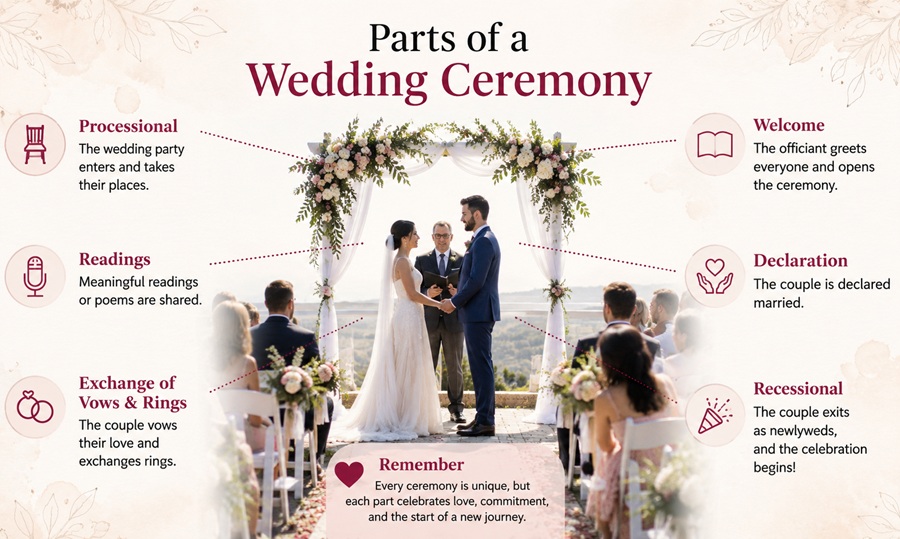
Step 1: The Processional
The ceremony opens with the wedding party walking down the aisle, typically in this order: officiant, groom or one partner, wedding party pairs, ring bearer and flower girl, and finally the person being escorted or walking in last for the big entrance.
Step 2: Welcome and Opening Remarks
The officiant welcomes guests, sets the tone for the ceremony, and often shares a brief statement about the couple’s relationship or the meaning of marriage. This is where humor, warmth, or a personal story about the couple usually appears.
Step 3: Readings or Blessings
Many couples include one or two readings here — a poem, scripture passage, or meaningful quote read by a close friend or family member. This step is entirely optional and often skipped in shorter ceremonies.
Step 4: The Officiant’s Address
Sometimes called the ‘homily’ or ‘charge to the couple,’ this is a short speech reflecting on love, commitment, and what marriage means, often tailored to the couple’s specific story.
Step 5: Exchange of Vows
Couples either recite traditional vows repeated after the officiant or read personally written vows. This is typically the emotional centerpiece of the ceremony.
Step 6: Exchange of Rings
Rings are presented, often by the best man or maid of honor, and exchanged with a short accompanying statement about their symbolism.
Step 7: Unity Ritual (Optional)
Many couples add a symbolic unity ritual here — a unity candle, sand ceremony, handfasting, or wine box — representing two lives joining as one. This step is entirely optional and cultural traditions vary widely.
Step 8: Pronouncement and First Kiss
The officiant formally pronounces the couple married, followed by the first kiss as a married couple, and often an introduction to guests by their new titles.
Step 9: The Recessional
The couple exits together down the aisle, followed by the wedding party, marking the transition from ceremony to celebration.
Common Cultural Variations
- Jewish ceremonies often include a chuppah and the breaking of a glass
- Christian ceremonies may include communion or a unity candle
- Hindu ceremonies typically involve multiple rituals spanning several hours, including the saat phere
- Secular ceremonies often replace religious language with personal storytelling
- Handfasting ceremonies, rooted in Celtic tradition, involve tying ribbons around joined hands
FAQs
Q: How long does a typical wedding ceremony last?
Most secular or short religious ceremonies run 20 to 30 minutes, while some religious or cultural ceremonies can extend to an hour or more.
Q: Can couples skip parts of the traditional order?
Yes, most couples customize the order, skipping readings or unity rituals, or adding personal elements like family involvement or music.
Q: Who typically walks down the aisle first?
Order varies by tradition, but the officiant and wedding party generally enter first, with the final entrance reserved for the most anticipated arrival.
Q: What’s the difference between a homily and vows?
The homily is the officiant’s reflection on marriage and the couple’s relationship, while vows are the couple’s personal promises to each other.
Q: Do all ceremonies need a unity ritual?
No, unity rituals are optional additions and not part of every tradition or every couple’s ceremony.