
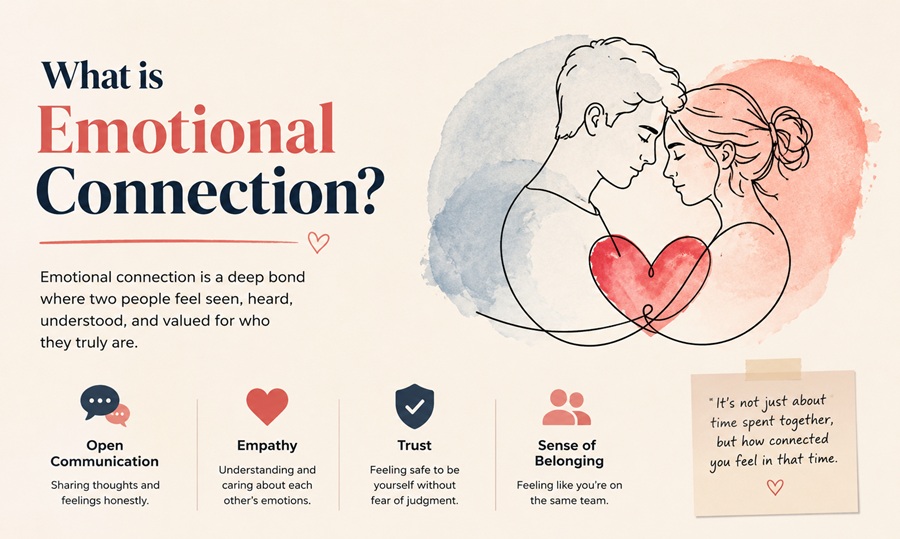
Quick Answer: Emotional connection is a felt sense of safety, understanding, and closeness between two people, built through vulnerability, consistent attention, and mutual trust. It differs from physical or intellectual attraction because it centers on feeling genuinely seen and accepted.
So, What Does “Emotional Connection” Actually Mean?
Q: Is emotional connection the same as chemistry?
Not quite. Chemistry is often an immediate spark — an attraction that happens fast and can fade just as quickly, often driven by physical attraction, novelty, or simple compatibility of humor and energy. Emotional connection is slower and sturdier. It’s built through repeated moments of being understood, supported, and accepted, and it tends to deepen over time rather than peak early, which is part of why it’s a much better predictor of long-term relationship health than initial chemistry alone.
Q: Can you have emotional connection without romantic feelings?
Yes. Emotional connection shows up in friendships, family relationships, and even some professional bonds. What makes it romantic is when it’s paired with attraction and exclusivity — but the underlying mechanism of feeling safely known is the same across relationship types. This is actually why some of the deepest emotional connections people describe are with lifelong friends rather than romantic partners; the romantic layer adds intensity, but it isn’t what creates the connection itself.
How Psychologists Define It
Q: Is there a clinical definition?
Attachment researchers describe emotional connection as a state in which both people feel their emotional bids — small moments of reaching out for attention, affirmation, or affection — are consistently noticed and responded to. Psychologist John Gottman’s research on “turning toward” bids is often cited here: relationships where partners respond positively to each other’s small requests for connection show measurably stronger bonds over time, while relationships where bids are consistently ignored or dismissed tend to erode even when both partners still care about each other.
Q: Why does this framework matter practically?
Because it reframes emotional connection as something built through hundreds of small, ordinary moments rather than a handful of grand gestures. A partner who consistently looks up from their phone when you start talking, remembers to ask how a stressful meeting went, or notices when your mood has shifted is doing the quiet, cumulative work that builds lasting connection.
Signs Emotional Connection Is Present
Q: How do I know if it’s really there?
- You feel comfortable being vulnerable without fear of judgment, even about things you rarely share with others
- Conversations go beyond logistics into feelings, values, and fears rather than staying at the level of scheduling and errands
- Silence together feels comfortable, not awkward — a strong indicator that presence itself feels safe
- You remember and reference small details the other person shared weeks or months earlier
- Conflict feels safe rather than threatening to the relationship itself, meaning disagreements don’t automatically spiral into fear of the relationship ending
- You find yourself genuinely curious about their inner world, not just their day-to-day activities
Signs It’s Missing
Q: What does the absence of emotional connection look like?
- Conversations stay surface-level even after significant time together
- One or both people avoid discussing feelings, redirecting toward logistics or humor instead
- Physical intimacy exists without emotional closeness, leaving one or both partners feeling hollow afterward
- You feel lonely even when physically together, a phenomenon sometimes described as being ‘alone together’
- Disagreements tend to escalate quickly or get avoided entirely rather than being worked through
How to Build Emotional Connection
Q: Can emotional connection be built intentionally, or does it just happen?
It can absolutely be built. Consistency matters more than grand gestures — regularly asking open-ended questions, practicing active listening, and being willing to share your own inner world all compound over time. Couples therapists frequently recommend a simple daily practice: ask your partner one question you don’t already know the answer to, which forces genuine curiosity rather than autopilot conversation.
Q: What role does vulnerability play?
A significant one. Emotional connection deepens fastest when both people take turns being the first to share something slightly uncomfortable — a fear, an insecurity, a past hurt — and the other person responds with warmth rather than judgment or dismissal. This reciprocal vulnerability is what psychologist Arthur Aron’s well-known closeness-generating research demonstrated decades ago, and it remains one of the most reliable tools for building connection quickly and durably.
Why It Matters for Long-Term Relationships
Q: Does emotional connection actually predict relationship success?
Research consistently links emotional intimacy to relationship satisfaction and longevity more strongly than physical attraction alone. Couples who report high emotional connection also report higher resilience during conflict and life stressors, because the relationship itself feels like a safe base rather than another source of pressure. This resilience shows up most clearly during difficult periods — job loss, illness, grief — where couples with strong emotional connection tend to draw closer together rather than drift apart.
Common Barriers to Emotional Connection
Q: What typically gets in the way of building emotional connection?
Busyness is the most common culprit — not dramatic conflict, but the slow erosion caused by two people simply not making time for real conversation amid work, parenting, and daily logistics. Screen time is a close second; even when partners are physically present, divided attention prevents the kind of focused engagement that emotional connection depends on.
Q: Can past experiences make emotional connection harder to build?
Yes. People who experienced inconsistent caregiving, betrayal, or emotional neglect earlier in life sometimes develop protective habits — deflecting vulnerability with humor, avoiding conflict entirely, or struggling to trust that a partner’s care is genuine. Recognizing these patterns, ideally with the support of a therapist, often becomes a necessary step before emotional connection can deepen further.
Small Daily Habits That Build Connection
Q: What does this look like in practice, day to day?
- A genuine greeting and goodbye each day, with real eye contact rather than a distracted glance
- Checking in about something specific your partner mentioned earlier, not just ‘how was your day’
- Physical affection that isn’t tied to a request for something else
- Naming your own feelings out loud, even small ones, to model openness
- Protecting a regular window of undistracted time together, even briefly
Emotional Connection Across Different Relationship Stages
Q: Does emotional connection look different in a new relationship versus a decades-long one?
Yes, considerably. In new relationships, emotional connection often builds through the excitement of discovery — learning a partner’s history, values, and quirks for the first time. In long-established relationships, it tends to rely more on maintenance than discovery, since much of that initial learning has already happened. Couples married for decades often describe emotional connection as something that requires periodic, intentional renewal rather than something automatically sustained by history alone.
Q: Can emotional connection be rebuilt after it fades?
Yes, and this is one of the most common goals brought into couples therapy. Rebuilding usually starts small — a single daily check-in, a weekly device-free conversation, deliberately noticing and responding to a partner’s bids for attention — rather than attempting a dramatic overhaul all at once. Consistency over weeks and months tends to matter more than any single grand gesture.
When to Seek Professional Support
Q: How do you know if a lack of emotional connection needs outside help?
If attempts to rebuild connection consistently stall, or if conversations about the disconnect repeatedly turn into conflict rather than understanding, a couples therapist can offer both a neutral space and specific tools tailored to the relationship’s particular patterns. This is especially worth considering if the disconnect has persisted for many months despite genuine effort from both sides, since an outside perspective can often identify blind spots neither partner sees clearly on their own.
Frequently Asked Questions
Q: Can emotional connection fade over time?
A: Yes, especially without intentional maintenance — busy schedules and routine can erode it, but it can also be rebuilt through renewed attention and communication, often faster than people expect once both partners commit to the effort.
Q: Is emotional connection the same as being ‘in love’?
A: They overlap but aren’t identical; you can be in love without full emotional connection, and emotional connection can exist in non-romantic relationships too, which is why some long marriages describe rebuilding emotional connection even after the initial romantic intensity has settled.
Q: How long does it take to build emotional connection with someone new?
A: There’s no fixed timeline — some people feel it within weeks through consistent vulnerability, while for others it develops over many months, and the pace often depends on how much genuine, undistracted time two people actually spend together.
Q: Can emotional connection exist without physical attraction?
A: Yes, and this is common in close friendships or family bonds, where deep understanding and trust exist without romantic or physical elements, demonstrating that the emotional mechanism itself is separate from romantic or sexual attraction.
Q: Is it possible to want emotional connection but struggle to build it?
A: Yes, this is common, particularly for people with past experiences of inconsistent caregiving or betrayal, and working with a therapist can help identify and shift the specific patterns getting in the way.
Q: Does technology make emotional connection harder?
A: It can, primarily through divided attention — being physically present but mentally elsewhere due to phones or other screens undermines the focused engagement that emotional connection depends on.
Conclusion
Emotional connection isn’t a mysterious spark you either have or don’t — it’s a pattern of attention, vulnerability, and consistent responsiveness that builds over time through hundreds of small, ordinary moments rather than a handful of dramatic ones. Whether you’re evaluating a new relationship or trying to deepen a long-standing one, the signs and practices above offer a practical starting point for recognizing where you stand and what to work on next, and the good news is that unlike chemistry, emotional connection is something both people can actively choose to build.