
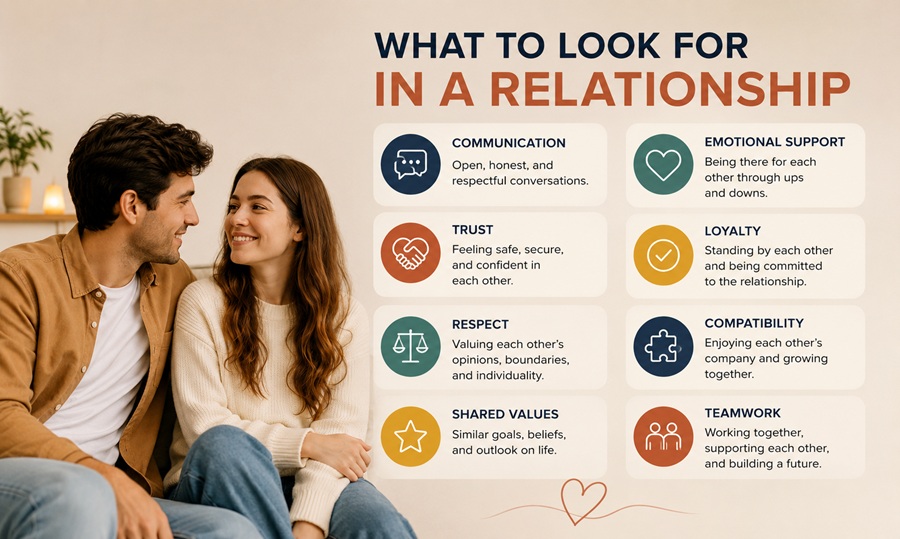
| Quick Answer
A healthy relationship should have mutual trust, respect, honest communication, emotional safety, and shared core values. Compatibility on lifestyle and future goals matters, but the strongest predictor of long-term success is how well two people handle conflict and support each other’s growth. |
Checklist ✅ Am I in a relationship worth investing in? It’s one of the hardest questions to answer honestly, especially when you’re already emotionally invested. Attraction and chemistry are easy to feel. Compatibility takes longer to assess. Below is a practical checklist of ten things worth genuinely evaluating — not as a scorecard to pass or fail your partner on, but as a way to check in with yourself about where things really stand.
The Checklist
☐ 1. Mutual Trust
Trust shows up less in big declarations and more in small consistencies — does your partner follow through on what they say? Do you feel secure when they’re not around? Trust that has to be constantly re-earned after small incidents is a sign worth paying attention to.
☐ 2. Respect, Especially During Disagreement
Watch how your partner treats you specifically when you disagree. Respectful partners can disagree without name-calling, mockery, or dismissiveness. This one criterion predicts relationship longevity better than almost any other.
☐ 3. Honest, Direct Communication
Healthy couples don’t avoid hard conversations indefinitely. They might not enjoy them, but they have them. If difficult topics get consistently dodged or minimized, resentment tends to build underneath the surface.
☐ 4. Emotional Safety
Can you be fully yourself — including your insecurities, fears, and less flattering moments — without fear of ridicule or punishment? Emotional safety is the foundation that everything else in a relationship is built on.
☐ 5. Shared Core Values
You don’t need to agree on everything, but alignment on the big things — honesty, family, ambition, how conflict should be handled — matters more than shared hobbies or interests.
☐ 6. Compatible Life Goals
Kids or no kids, where to live, career priorities, financial philosophy — these aren’t details to sort out later. Major mismatches here tend to resurface repeatedly if left unaddressed early.
☐ 7. Support for Individual Growth
A healthy partner wants you to grow, even when that growth doesn’t directly benefit them. Watch for subtle discouragement disguised as concern.
☐ 8. Healthy Conflict Resolution
Every couple argues. The question is whether arguments resolve and lead somewhere, or repeat in a loop without ever actually getting fixed.
☐ 9. Physical and Emotional Affection
Affection styles vary, but some baseline warmth — verbal or physical — should be present and mutual, not one-sided.
☐ 10. Consistency Between Words and Actions
Perhaps the simplest check of all: does what your partner says match what they actually do over time? Consistency, more than any single grand gesture, is what compatibility is built on.
Quality vs. Compatibility: Two Different Questions
It’s worth separating two questions people often blend together: is this a good person, and are we a good match? A kind, trustworthy person can still be the wrong long-term fit if your core values or life goals diverge. Both questions deserve honest answers.
| Category | What to Watch For | Green Flag Example |
| Trust | Consistency between words and actions | Follows through without needing reminders |
| Communication | Willingness to discuss hard topics | Brings up concerns instead of letting them fester |
| Values | Alignment on big-picture priorities | Similar views on family, honesty, ambition |
| Conflict | How disagreements resolve | Comes back to repair after an argument |
Red Flags Worth Slowing Down For
- Consistent dismissiveness of your feelings or concerns
- Pattern of broken promises with no accountability
- Discomfort with your independence or outside relationships
- Avoidance of any conversation about the future
- A pattern where apologies never lead to changed behavior
| Warning: One or two of these red flags in isolation doesn’t necessarily mean the relationship is doomed — everyone has bad days. A consistent pattern over months, however, is worth taking seriously. |
Why This Checklist Matters More Early On
Most people evaluate compatibility instinctively, based on how a relationship feels in the moment, rather than deliberately, based on how a partner behaves across different circumstances. That instinctive approach works reasonably well for spotting obvious dealbreakers, but it’s far less reliable for catching subtler mismatches — differences in communication style, conflict tolerance, or long-term goals — that only become clear once the initial excitement of dating settles. Running through a checklist like this one periodically, rather than only at the start, helps catch issues while they’re still small and addressable.
How to Have This Conversation With a Partner
If working through this list surfaces genuine concerns, the next step is usually a direct, non-accusatory conversation rather than silent worry or an ultimatum. Frame it around your own observations and feelings — ‘I’ve noticed we don’t talk much about the future, and it’s been on my mind’ — rather than framing it as a demand or an attack. How your partner responds to that kind of vulnerable, honest opening often tells you as much as their actual answer does.
When to Trust Your Gut vs. When to Communicate First
Instinct and communication aren’t opposites — they work best together. If something feels off, that feeling is worth paying attention to, but it’s rarely enough information on its own to make a major decision. Use your gut reaction as a signal to start a conversation, not as a final verdict. Often, what feels like a red flag turns out to be a misunderstanding once it’s actually discussed; other times, the conversation confirms the concern was valid. Either way, you’ll know more than you did before, which is the real value of checking in with yourself regularly.
How This Checklist Changes at Different Relationship Stages
Early in dating, this checklist is mostly about observation — watching for patterns in how someone communicates, treats others, and follows through on what they say, without yet having enough history to fully evaluate deeper compatibility. In an established relationship, the checklist shifts toward evaluation over time — has trust actually held up under real pressure, has conflict resolution genuinely improved or just gone quiet, do shared goals still align as both people’s circumstances and priorities evolve. Revisiting this list at different points, rather than treating it as a one-time evaluation, gives a much more accurate picture than a single early assessment can.
What This Checklist Isn’t Meant to Do
It’s worth being clear about the limits of any checklist like this one. It’s not designed to produce a perfect, objective score that determines whether you should stay or leave — no relationship checks every box all the time, and healthy relationships still involve friction, disagreement, and imperfect moments. The goal is self-awareness, not a pass-or-fail verdict. Use it as a prompt for honest reflection and conversation, not as a rigid test your relationship either passes or fails.
Frequently Asked Questions
What’s the most important thing to look for in a relationship?
Mutual respect, especially during disagreement, is frequently cited by relationship researchers as one of the strongest predictors of long-term relationship health.
Is chemistry enough for a relationship to work long term?
Chemistry helps sustain early attraction, but shared values, communication, and how conflict is handled matter more for long-term compatibility.
How do you know if you’re settling in a relationship?
Common signs include consistently minimizing your own needs, staying mainly out of fear of being alone, or feeling relief rather than joy when your partner is around.
Can two people with different values still have a healthy relationship?
It’s possible if the differences are in less central areas and both partners genuinely respect the other’s perspective, but major misalignment on core values tends to create ongoing friction.
How long should you date before evaluating long-term compatibility?
There’s no fixed timeline, but most relationship experts suggest giving it at least several months to see how a partner behaves across different situations, including stress and conflict.
None of these ten criteria exist to turn dating into a spreadsheet exercise. They’re a starting point for an honest gut check — one worth revisiting periodically, not just at the beginning of a relationship. If most of this checklist feels true for you and your partner, you likely have a solid foundation. If several items consistently don’t, that’s information worth sitting with, not ignoring.